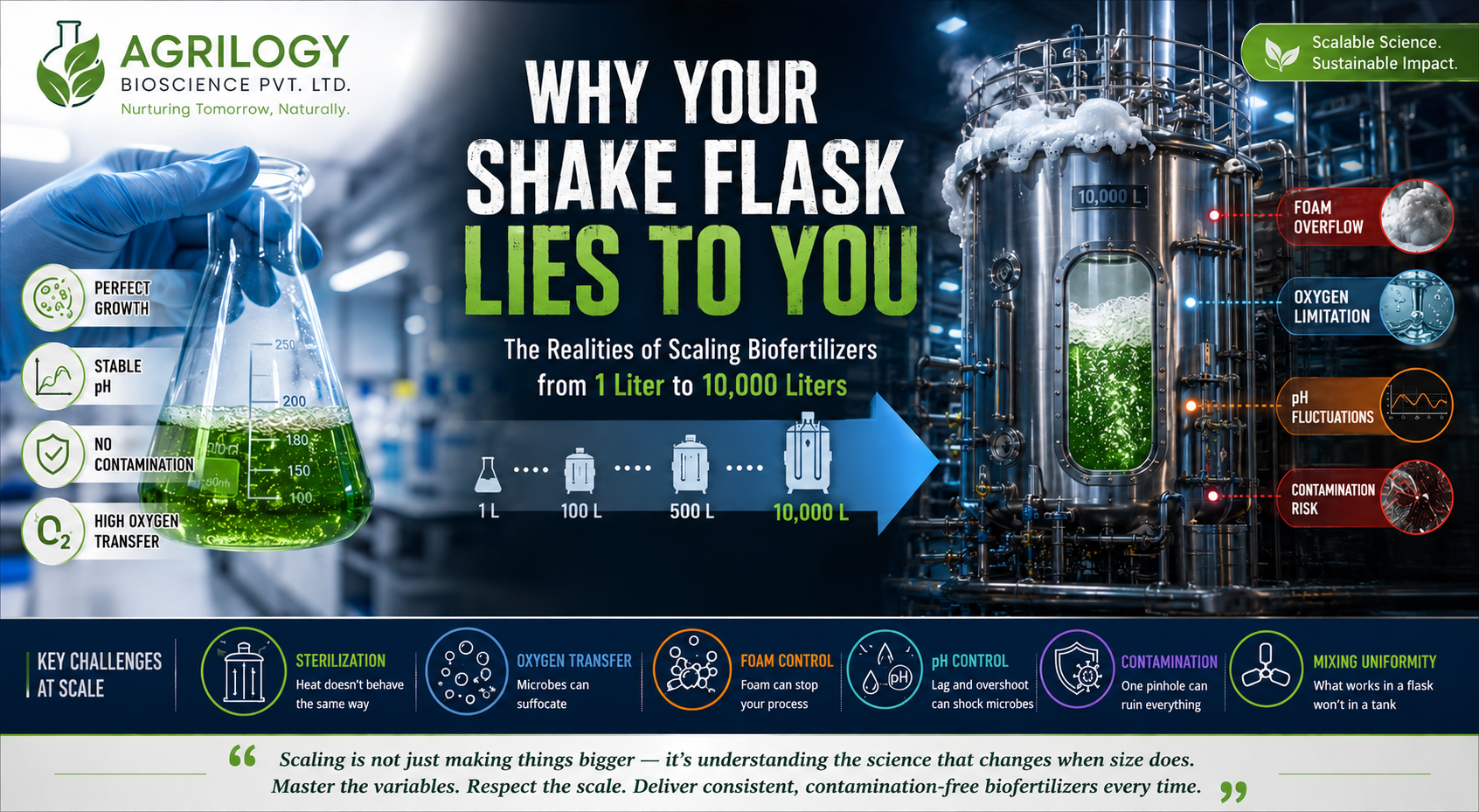

Why Your Shake Flask Lies to You: The Realities of Scaling Biofertilizers to 10,000 Liters
You made a perfect 1L batch. Good growth, clean microscopy, nice pH curve. Everyone’s happy.
Then the boss says: “Scale it to 10,000 liters.”
It sounds simple. Just use a bigger tank, right? Wrong. Here’s the actual science of why small-scale success doesn’t guarantee large-scale wins—and what you can do about it.
1. Sterilization: Heat Doesn’t Behave the Same Way
The problem at 1L:
Your autoclave saturates the flask with steam. Heat penetrates quickly. The whole flask reaches 121°C within minutes.
The problem at 10,000L:
A large bioreactor has thick walls, internal coils, and dead zones. Steam or electric heating creates temperature gradients.
- Near the heating jacket: Too hot → caramelized sugars, denatured vitamins.
- In the center or near the bottom: Too cold → surviving spores (Bacillus, fungi).
Deeper explanation:
Heat transfer is governed by surface area to volume ratio. A 1L flask has high surface area relative to volume. A 10,000L tank? Very low. So heat moves slowly. Also, liquid convection isn’t enough—you need active mixing during sterilization, but many reactors can’t stir while heating.
What to actually do:
- Use live steam injection directly into the medium (faster, more uniform).
- If using jacket heating, hold sterilization longer (e.g., 45-60 min instead of 20 min).
- Map temperature with multiple probes before your first real run.
- Never assume “it works at small scale” means it works big.
2. Oxygen Transfer: Your Microbes Are Suffocating
The problem at 1L:
A flask on an orbital shaker creates a huge gas-liquid interface. Oxygen dissolves easily. The shaking also constantly renews the surface.
The problem at 10,000L:
In a deep tank, an air bubble from the sparger takes seconds to rise. By the time it reaches the top, most oxygen is already used up. Microbes near the bottom get plenty; those near the top get almost none.
Deeper explanation:
Oxygen transfer is measured by kLa (volumetric mass transfer coefficient). At 1L, kLa is naturally high. At 10,000L, kLa drops dramatically unless you force it. You increase aeration rate? Fine. But increase impeller speed too much, and shear stress rips apart delicate microbes like Rhizobium or Azospirillum. Their cell membranes literally tear.
What to actually do:
- Use higher air flow rates (but not too high—foam issues).
- Use microsparger (tiny holes) instead of a single hole for finer bubbles.
- Choose low-shear impellers (e.g., marine propellers or pitched-blade turbines), not rushton turbines.
- Measure dissolved oxygen online and keep it above 30% saturation.
- Do a kLa test (gassing-out method) before your run—don’t guess.
3. Foam: Not Cute Anymore
The problem at 1L:
A bit of foam sits on top. You might add one drop of anti-foam. Fine.
The problem at 10,000L:
Proteins, polysaccharides, and microbial byproducts stabilize foam. At large scale, the linear air velocity at the sparger creates millions of tiny bubbles. These rise as a dense foam column that can block the exhaust filter. When that happens:
- Pressure builds up → filter bursts or safety valve opens.
- Contaminants from outside get sucked in.
- Liquid foam carries microbes into the exhaust line → cross-contamination risk.
Deeper explanation:
Foam stability increases with scale because bubble residence time is longer. Also, mechanical agitation whips air into the liquid. The classic lab trick (“shake harder”) fails because big impellers create different bubble size distributions.
What to actually do:
- Use a mechanical foam breaker (spinning discs) as first line of defense.
- Add chemical anti-foam (silicon or oil-based) automatically via a foam sensor—never manually.
- Don’t over-add anti-foam: it coats cells and reduces oxygen transfer by up to 50%.
- Design your tank with extra headspace (at least 30% of total volume).
4. pH Control: The Lag Will Trick You
The problem at 1L:
You add one drop of 1N NaOH, swirl, pH changes nicely. Easy.
The problem at 10,000L:
You add 500 mL of 5N NaOH via a pump. The pH probe is at the top. The base sinks to the bottom first. For 30 seconds, the probe still reads 6.8—so the controller adds more base. Then the mixing wave hits, and pH jumps from 6.8 to 9.2. Microbes experience pH shock.
Deeper explanation:
This is called mixing time vs. response time. In a 10,000L tank, complete mixing (95% homogeneity) can take 60-120 seconds. Your pH probe and controller respond in seconds. So you overshoot. Also, many biofertilizer microbes (like Azotobacter) have narrow pH ranges (6.5-7.5). A swing of 1.5 units can stop nitrogen fixation temporarily.
What to actually do:
- Add base/acid very slowly with a peristaltic pump, not a solenoid valve.
- Position the pH probe near the addition point OR use multiple probes.
- Use a cascade control (add slowly, wait, check, then add more).
- If possible, buffer your medium (e.g., with phosphate or calcium carbonate) to resist swings.
5. Contamination: One Pinhole Ruins Everything
The problem at 1L:
You see contamination under the microscope. You dump the flask. No big loss.
The problem at 10,000L:
Contamination after 72 hours of growth means losing tens of thousands of dollars. The worst part? The cause is often something tiny:
- A leaking mechanical seal on the impeller shaft (you can’t see it, but air gets in).
- A cracked sight glass (thermal stress from sterilization cycles).
- Backflow from a harvest valve that wasn’t steamed properly.
- Condensate from the exhaust line dripping back into the tank.
Deeper explanation:
At large scale, the pressure differential changes constantly. When you cool down after sterilization, the tank pulls a vacuum. If any seal leaks inward, airborne spores get sucked in. Also, biofertilizer media are rich (molasses, peptone, yeast extract)—perfect food for any contaminant.
What to actually do:
- Do a pressure hold test (0.5-1 bar air, hold for 30 minutes, no drop).
- Inspect every gasket and O-ring before every run. Replace annually.
- Maintain positive sterile air pressure on all seals using a barrier system.
- Steam all inlet and outlet ports before and after inoculation.
- Have a contamination response plan (when to dump, when to try to salvage).
6. Nutrient Uniformity: Some Microbes Feast, Some Starve
The problem at 1L:
Shaking mixes everything perfectly. Every microbe gets the same sugar and minerals.
The problem at 10,000L:
Without perfect mixing, denser components (like molasses or phosphate salts) can settle. Also, microbes growing faster at the bottom consume oxygen and release acids. The top zone might be sugar-depleted while the bottom still has plenty. You get heterogeneous growth—different cell densities in different zones.
Deeper explanation:
Large tanks have dead zones (near baffles, corners, the bottom dish). In these zones, mixing is poor. Microbes there age, lyse, and release enzymes that can spoil the whole batch. Also, if you feed nutrients (fed-batch), the feed point location matters enormously. Feed at the top? Sugar sinks slowly. Feed at the bottom? Local high concentration inhibits growth (substrate inhibition).
What to actually do:
- Use dual impellers (one top, one bottom) with axial flow blades.
- Take samples from top, middle, and bottom ports—don’t trust one sample.
- Add feed near the middle impeller for fastest distribution.
- Run a mixing time test using a dye or salt pulse before your culture.
The Lab Worker’s Reality Checklist
Before you approve that 10,000L run, ask:
- Did we pilot at 100L or 500L? (Never skip this. The jump from 100L to 10,000L is hard enough. 1L to 10,000L is impossible without intermediate scale.)
- Are our probes calibrated and response-tested at large scale? (pH and DO probes behave differently in deep tanks.)
- Do we have online foam control? Not a bottle in your hand.
- Is our inoculum train big enough? (10,000L needs at least 500-1000L of healthy starter, grown in a seed reactor. One shake flask won’t cut it—lag phase will be days long.)
- Have we done a water run (no microbes) to check mixing, sterilization, and cooling?
Final Honest Take
Scaling up is humbling. Your beautiful 1L process will break in the big tank. That’s not failure—that’s physics.
But here’s the real secret: every large-scale problem is just a small-scale problem you didn’t notice because the numbers were tiny. Now you see it. Now you can fix it.
Take it slow. Test everything. Respect the tank. And always, always have extra anti-foam within arm’s reach.