
Golden Is Good… But So Are White and Pale Yellow Spores—Here’s the Science
A Story from the Farm That Opened Everyone’s Eyes
A farmer once visited our field demo carrying two samples of mycorrhiza spores.
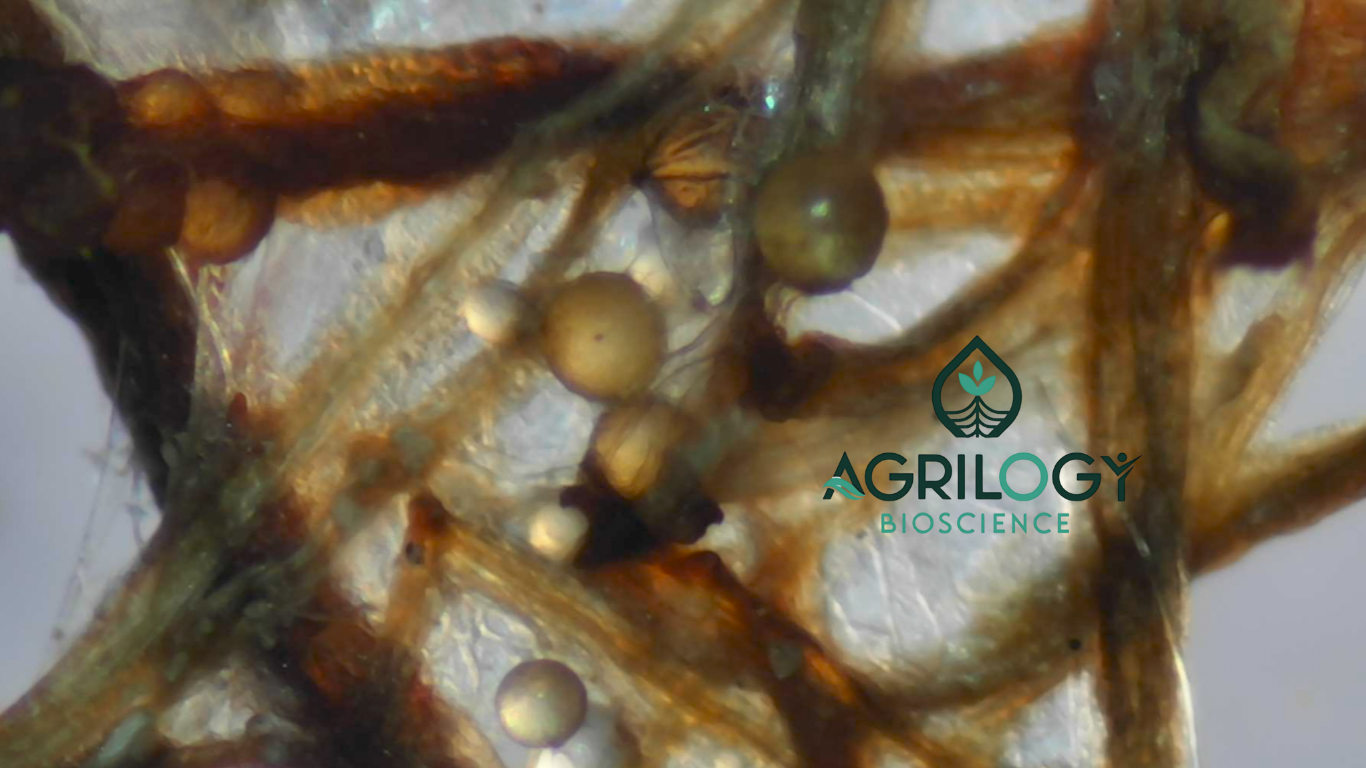
One had golden-yellow spores—bright, shiny, and visually impressive.
The other had white and pale-yellow spores—simple, dull, easy to underestimate under microscopy.
He asked:
“Saheb, aa banema thi kayu sachu kaam karse? (Which one will work better?)”
Almost everyone pointed to the golden spores.
But the soil told a different story!
When we tested both samples:
- Some golden spores did not stain in the MTT assay → meaning they were dormant or old
- The white and pale-yellow spores turned deep blue hue→ showing strong viability and active metabolism
- Pale spores colonized roots more quickly
- Field plots with pale spores showed better early growth and stronger root networks
The farmer was surprised.
But this is exactly what the science says: Golden spores are good—but white and pale-yellow spores are equally good, often even more active.
Why Colour Alone Misleads Us
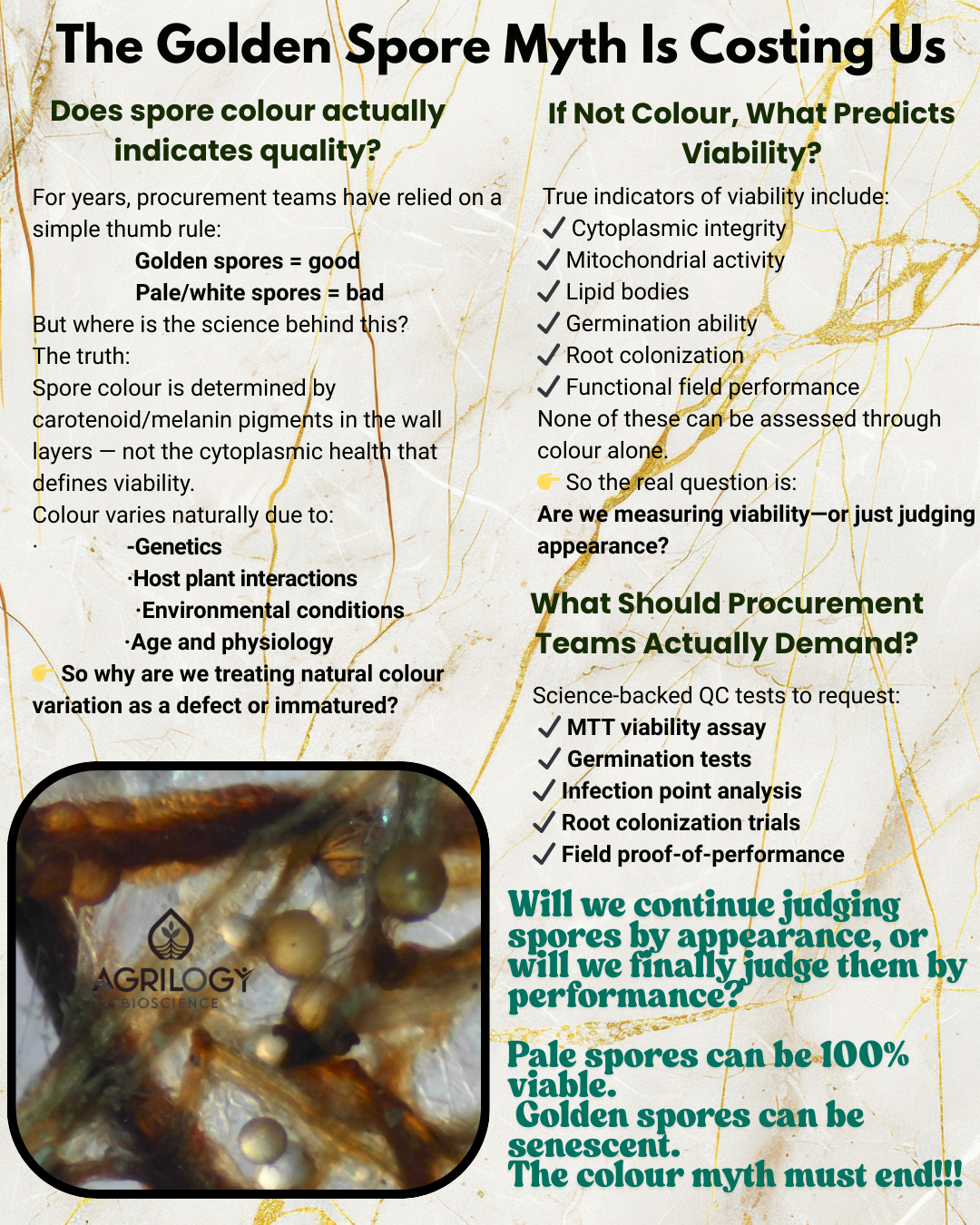
A mycorrhiza spore’s colour—whether white, pale yellow, cream, or golden—naturally varies due to its genetics, the host plant it grew with, the soil and environment it developed in, its age, and the carotenoid pigments in its outer wall. Because these factors influence only the outer appearance, colour alone cannot indicate a spore’s internal health or viability. Just like wheat grains that differ slightly in shade but grow equally well, mycorrhiza spores also show harmless colour variation. The real indicator of quality is not colour, but whether the spore is alive and capable of colonizing roots.
White and Pale-Yellow Spores: Naturally Efficient Contributors to Soil Health
White and pale-yellow AMF spores are not weak or immature—multiple authoritative sources, including INVAM (International Culture Collection of Arbuscular Mycorrhizal Fungi) and GINCO-BEL (Belgian Glomeromycota Collection), document that many well-known, highly functional AMF species naturally produce spores in lighter shades. These pale-coloured spores belong to species that play a strong role in nutrient mobilization, hyphal spread, soil aggregation, and root colonization, often performing as effectively as darker or golden spores. AMF reference databases also show clear evidence that pale-coloured spores are common in Glomeraceae and other agriculturally important families, where colour variation is considered a normal taxonomic trait, not a sign of poor quality.
Because of this natural diversity (Polymorphism), pale and white spores consistently contribute to soil ecology by improving phosphorus and micronutrient uptake, enhancing water-use efficiency, increasing soil microbial activity, and supporting carbon storage through extensive hyphal networks.
Thus, the presence of white or pale spores in a product is fully aligned with natural AMF biology and reflects the diversity found in verified, curated AMF collections worldwide.
Myth vs. Reality: Colour Does Not Indicate Viability
It is a common belief that yellow or golden spores are always viable and white or pale spores are non-viable, but MTT assays and global AMF references show this is not true. Golden spores often fail to stain in MTT because they may be senescent, dormant, or pigmented in a way that limits dye penetration, meaning their colour alone cannot confirm activity or viability. In contrast, white and pale-yellow spores frequently stain deep blue, indicating active metabolism, healthy cytoplasm, and readiness to germinate.
So the reality is clear:
Yellow spores are not automatically viable, and white/pale spores are not automatically non-viable. Viability depends on the internal physiology of the spore, not its colour.
What Actually Determines Spore Quality?
Real quality depends on:
- Germination ability
- Cytoplasmic health
- MTT viability
- Hyphal growth
- Root colonization %
- Infection points
- Field performance
Not on colour.
Colour only tells appearance—not power.
Appearance Isn’t Quality: Rethinking AMF Procurement Standards
For procurement teams, judging spore quality by colour alone may seem simple, but it causes significant hidden losses. When white or pale-yellow spores are rejected purely because they don’t “look” ideal, procurement unknowingly discards many viable, high-performing spores that global AMF collections such as INVAM and GINCO-BEL consider completely natural. This leads to avoidable batch rejections, reduced usable output, higher production costs, and inconsistent final product quality.
Colour-based filtering also increases the risk of supplying farmers with visually appealing—but biologically weaker—products. By removing pale spores that often show strong metabolic activity in tests like MTT, procurement unintentionally reduces the overall viability of the formulation. This undermines field performance and long-term trust in the brand.
Moreover, rejecting pale spores deprives the soil of beneficial fungi that contribute to nutrient uptake, root development, and soil structure. These losses highlight why global AMF experts do not use colour as a quality parameter. Procurement accuracy improves dramatically when decisions are based on functional viability, germination, and colonization ability, rather than superficial appearance.
What Should Be Practical Action Check List?
1. Update Procurement SOPs
Adopt the natural colour range of AMF spores — white, cream, pale yellow, and light golden — as acceptable and normal variations.
2. Train QC & Field Teams
Clarify that lighter spores are not weak; they are natural and often show higher metabolic activity in viability tests.
3. Educate Farmers in Simple Terms
Use farmer-friendly explanations such as:
“Spore nu rang quality nathi batavtu; MTT ma neelo rang jivant spore batave chhe.”
4. Follow Science-Based Quality Checks
Rely on MTT viability, germination, and colonization efficiency, rather than colour-based selection.
5. Promote Soil-Health–First Communication
Show how pale spores improve nutrient uptake, root strength, and long-term soil fertility year after year.
Spore Colour Is Just Nature; Viability Is the Truth
Golden spores are good.
White spores are good.
Pale-yellow spores are good.
Every colour is simply a part of nature’s diversity—and all can support strong roots, healthy soil, and better crops. What truly matters is viability, not appearance.
It’s time to move beyond colour myths and build a future driven by science, soil health, and honest quality standards that deliver real value to farmers.
Because ultimately…
Crops don’t grow from the colour of the spore—they grow from the life and activity within it.