
The Invisible Gradient: Why Oxygen Distribution Might Be the Real Difference Between Good and Great Trichoderma
The green carpet on our SSF trays is beautiful, no doubt. But if you look past the colour and focus on what the fungus is actually breathing, a far more interesting story unfolds.
We talk a lot about moisture, temperature, and substrate composition. But there is another parameter—silent, invisible, and arguably more decisive—that separates a mediocre batch from a biochemically potent one. That parameter is oxygen.
And here is the twist: how oxygen reaches Trichoderma in Solid-State Fermentation (SSF) is fundamentally different from how it works in Submerged Fermentation (SmF). Understanding this difference isn't just academic trivia. It explains why SSF produces spores that are biochemically primed for the monsoon—and why the oxygen gradient within our trays might be the secret ingredient we have been overlooking.
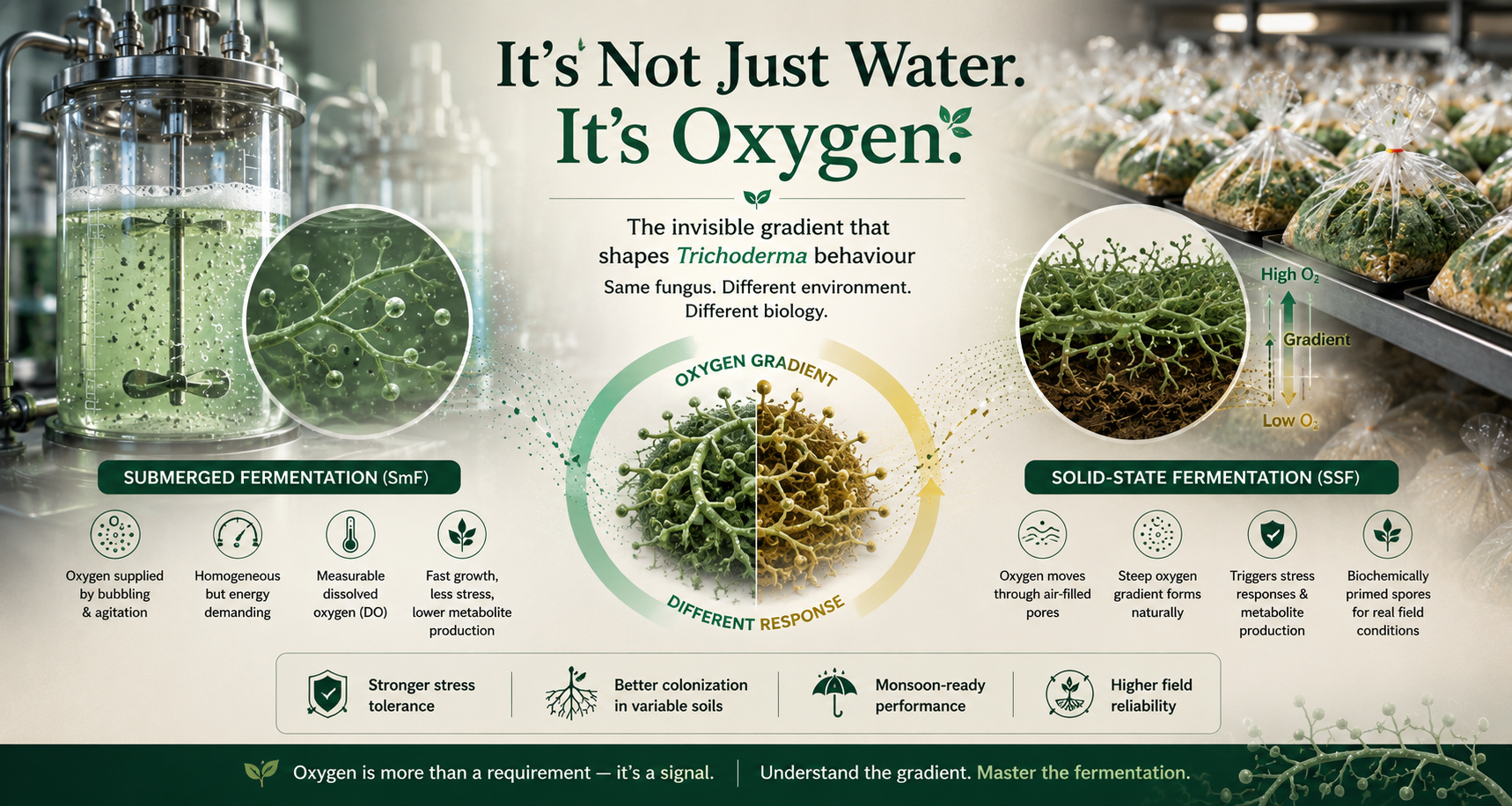
The SmF Oxygen Reality: Homogeneous but Demanding
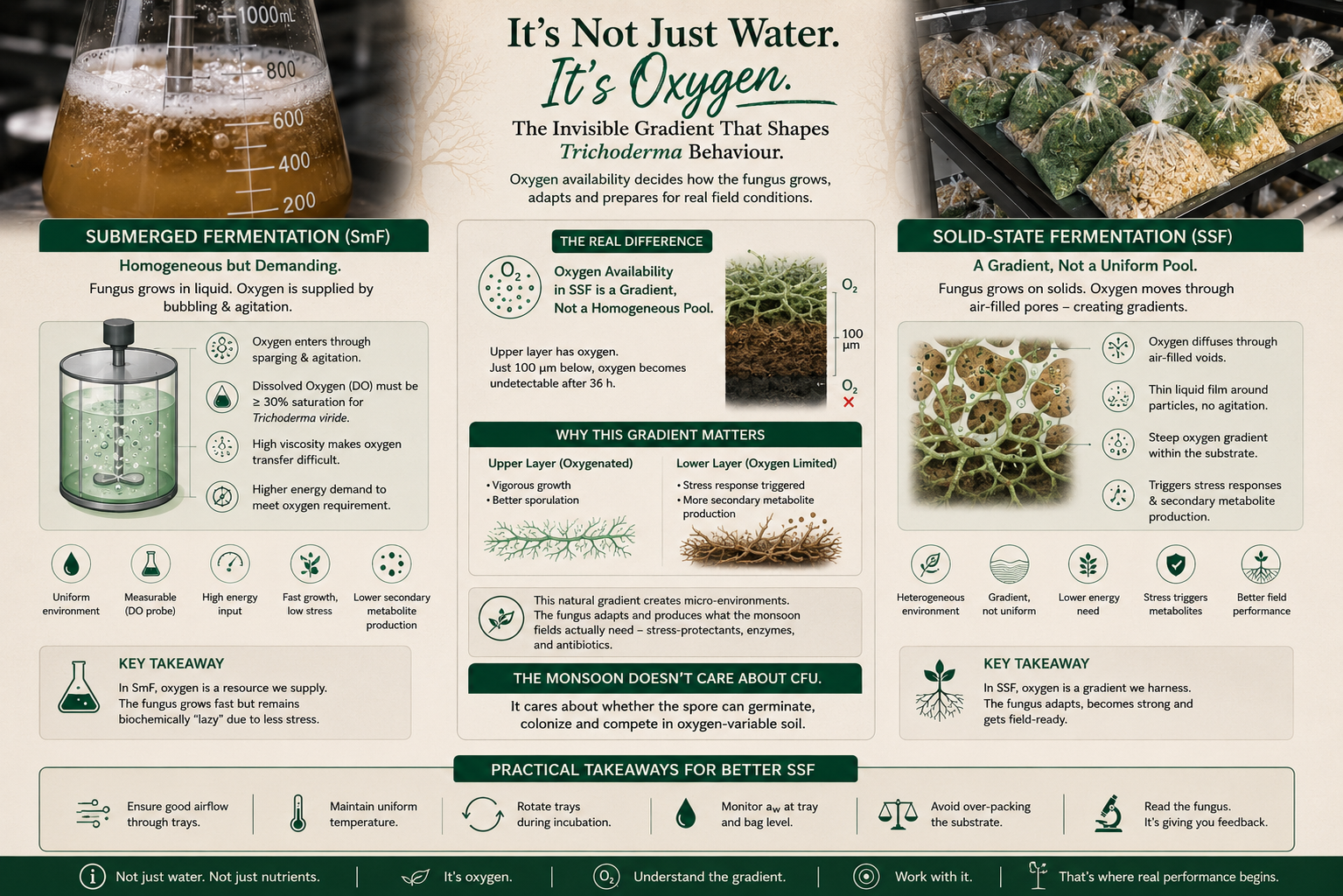
In submerged fermentation, Trichoderma grows in a liquid broth—water, sugars, nutrients, all mixed together. Oxygen enters the system through sparging (bubbling air) and mechanical agitation. The gas bubbles diffuse into the liquid, dissolve at the gas-liquid interface, and then travel through the bulk liquid to reach the fungus.
This setup is relatively predictable. Dissolved oxygen (DO) concentration can be measured with a probe. The volumetric oxygen mass transfer coefficient is a standard parameter that engineers track closely.
For Trichoderma viride, maintaining dissolved oxygen at or above 30% saturation is critical for growth and conidia production. Drop below that, and the fungus struggles.
But here is the catch: Trichoderma is a filamentous fungus. As it grows, it develops hyphae, creating a highly viscous, shear-thinning medium. This viscosity makes oxygen transfer increasingly difficult. To keep up with the oxygen demand, agitation and aeration requirements escalate significantly, especially at higher biomass concentrations. The system becomes energy-intensive and technically demanding.
The SSF Oxygen Reality: A Gradient, Not a Homogeneous Pool
Now, shift your gaze to our SSF trays. The fungus grows on the surface of solid particles—rice bran, wheat straw—surrounded by a thin liquid film and air-filled void spaces. The water content is low, typically around 55–60%. There is no bulk liquid. There are no bubbles. There is no mechanical agitation.
So, how does oxygen reach the fungus?
Here is the counterintuitive part: oxygen mass transfer is actually more efficient in SSF than in SmF—on paper, at least. Why? Because the fungus is in close contact with the gaseous oxygen that flows through the void spaces between solid particles. The higher area-to-volume ratio of the solid matrix facilitates oxygen transfer. In theory, oxygen is everywhere.
But "everywhere" is not the same as "available."
In reality, SSF creates steep oxygen concentration gradients. The fungal mat itself develops into layers—an upper layer of sparse aerial hyphae with gas-filled pores, and a dense bottom layer with liquid-filled pores. Oxygen microelectrode measurements have shown that while the upper aerial layer remains oxygenated, oxygen becomes undetectable just 100 micrometres below the gas-liquid interface after 36 hours of cultivation.
Let that sink in. One hundred micrometres. That is thinner than a human hair. And yet, oxygen cannot penetrate beyond that depth.
The consequence? The fungus in the deeper, wetter layers experiences oxygen depletion. And when oxygen is limited, Trichoderma viride shifts its metabolism. It switches to a fermentative pathway, producing ethanol, succinate, and other carboxylic acids. The appearance of secondary metabolites is directly modified by oxygen availability.
Why This Gradient Matters for Your SSF Trays
This oxygen gradient is not a problem to be solved. It is a feature—and perhaps the very reason SSF produces such potent biocontrol agents.
The gradient creates microenvironments within a single tray. The upper layers, bathed in oxygen, support vigorous growth and sporulation. The deeper layers, oxygen-limited, trigger stress responses that upregulate secondary metabolite production. The fungus is not a uniform mass; it is a heterogeneous population responding to local conditions. And heterogeneity, in this context, might be a good thing.
The Practical Takeaway
- In SmF, oxygen is a resource you must constantly supply. It is homogeneous, measurable, and energy-intensive to maintain. The fungus grows fast but biochemically "lazy" because stress is minimised.
- In SSF, oxygen is a gradient. It is heterogeneous, self-organising, and creates natural stress zones within the substrate. The fungus adapts—producing stress-protectants, antibiotics, and enzymes in response to local oxygen depletion.
The monsoon doesn't care about your CFU count. It cares about whether the spore can germinate, colonise, and compete in oxygen-variable soil conditions. And that readiness? It is forged in the oxygen gradients of your SSF trays.
The question that lingers:
Are we still treating oxygen as a simple "supply" problem—or are we ready to embrace the gradient as a deliberate tool for biochemical conditioning?
Our trays have been telling us this story all along. It is time we started listening.
What the Green on Our Trays Is Really Telling Us
The lab has that distinct smell again. Earthy, slightly sweet, with a ghost of coconut lingering near the incubation racks. That’s 6-pentyl-α-pyrone off-gassing from our Solid-State Fermentation trays.
Monsoon is almost here. And if you look past the sales charts and the farmer helplines buzzing in the background, what we’re actually doing in this room is far more fascinating than just scaling up a biopesticide.
We are forcing a microscopic organism to make a life-or-death biochemical decision.
Walk through our production floor, and you will see the trays. Stacked high. Filled with agricultural waste—rice bran, wheat straw —all knitted together by that unmistakable green mycelial mat. Visitors usually ask about the "yield." How many spores per gram? What’s the CFU count?
I used to ask those questions too. But lately, I have started asking a different one: What exactly are we harvesting?
If you compare this to liquid fermentation, the difference is staggering.
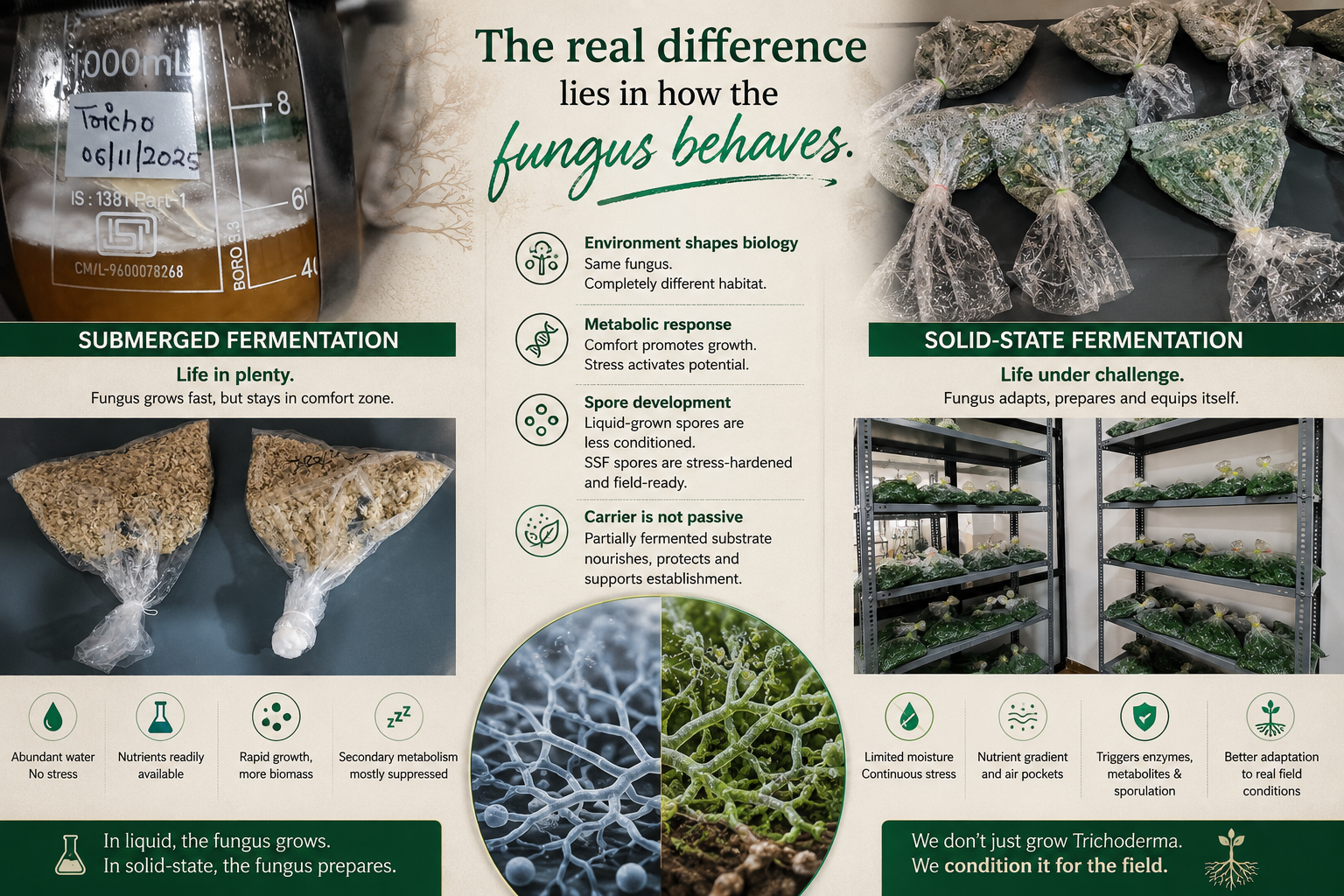
In a liquid broth, Trichoderma lives like a spoiled child. Unlimited water, abundant dissolved sugars, constant agitation. It grows fast, sure. But biochemically? It gets lazy.
The genes responsible for producing its chemical weapons—the polyketides, the peptaibols, the volatile antibiotics—mostly stay switched off. Why fire a missile when there is no war?
Solid-state fermentation flips that comfort zone upside down.
The moment we mix the substrate to that narrow sweet spot of 55-60% moisture, we create a physical paradox for the fungus. It is surrounded by solid particles, air pockets, and just enough water to survive, but not enough to thrive without effort.
The low water activity and the gradient of nutrients across the solid matrix act as a constant, low-level stress signal.
And stress, as every biochemist knows, is the greatest catalyst for secondary metabolism.
Under this subtle pressure, Trichoderma wakes up. It ramps up its non-ribosomal peptide synthetases.
It starts pumping out chitinases and glucanases, not just into a diluted liquid medium, but right into the micro-pores of the substrate where they concentrate to remarkably high local levels.
When that spore eventually lands in a waterlogged paddy field, it doesn't start from scratch. It carries those pre-formed enzymes with it, like a soldier carrying a loaded weapon to the frontline. The pathogen doesn't stand a chance.
There is another layer to this that doesn't get enough attention—the biochemistry of the spore itself.
Spores harvested from SSF trays are not the same as those washed out of a bioreactor.
Under the low-water stress of solid substrates, the fungus accumulates protective solutes like trehalose and mannitol. These are nature’s antifreeze and desiccation protectants.
Monsoon soils are brutal—they swing from saturated to dry and back again within days.
A liquid-cultured spore, with its thinner biochemical armor, often gets caught off guard. But an SSF-matured spore? It has already survived the harshest conditions of the production floor. It is biochemically primed to germinate aggressively the moment it senses root exudates.
And I haven't even mentioned the carrier yet.
We tend to think of the spent substrate as just that—spent. Inert. A vehicle to get the spores from our lab to the field. But that partially fermented agricultural waste is a biochemical time-release capsule. It is loaded with residual reducing sugars, organic acids, and even some of the very volatile organic compounds that Trichoderma uses to communicate with plant roots.
When the farmer mixes this powder with water and applies it to the soil, that carrier doesn't just dissolve away. It feeds the germinating spores, gives them a head start, and acts as a prebiotic cushion in the rhizosphere.
So, standing here with a tray in my hands, looking at the dense green sporulation, I no longer see a "mass multiplication unit." I see a miniature biochemical reactor where nature’s most sophisticated fungal agent is forced to reveal its full arsenal.
We are not growing Trichoderma here. We are negotiating with it. We provide the physical stress, the solid matrix, the imperfect environment—and in exchange, it gives us everything it has. The antibiotics. The lytic enzymes. The stress-protectants. The signaling molecules. All compressed into that green powder.
The monsoon doesn't make this product sell. The monsoon simply wakes up the biochemistry that we have already drawn out out of the fungus, weeks in advance, right there on those trays.
The question that keeps me up at night is this: Are we still evaluating our product purely by the number of green dots on a hemocytometer? Or are we finally ready to measure what actually matters—the biochemical maturity of every single spore we send out the door? Because looking at these trays, I think the fungus has already made its choice. It’s time we made ours.
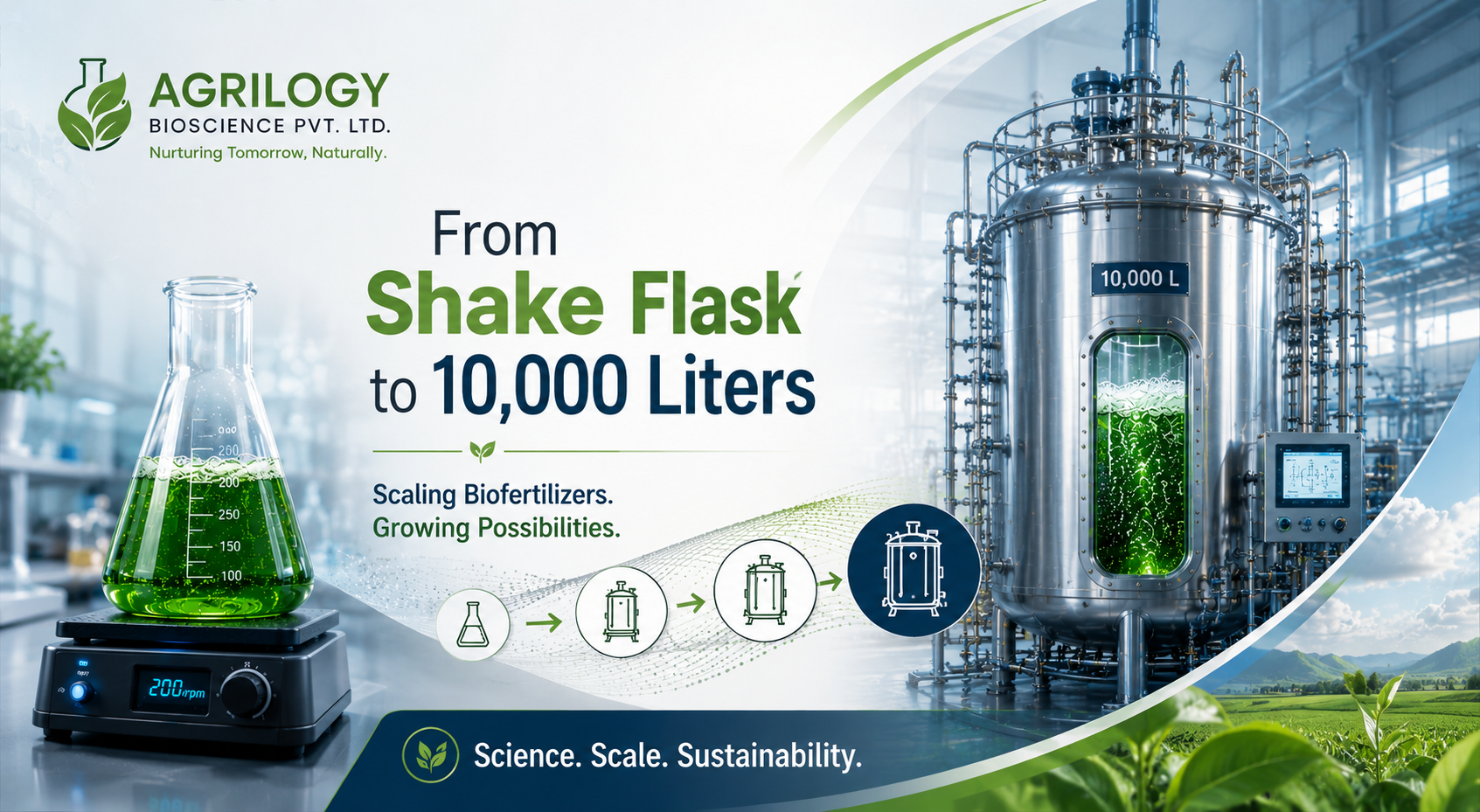
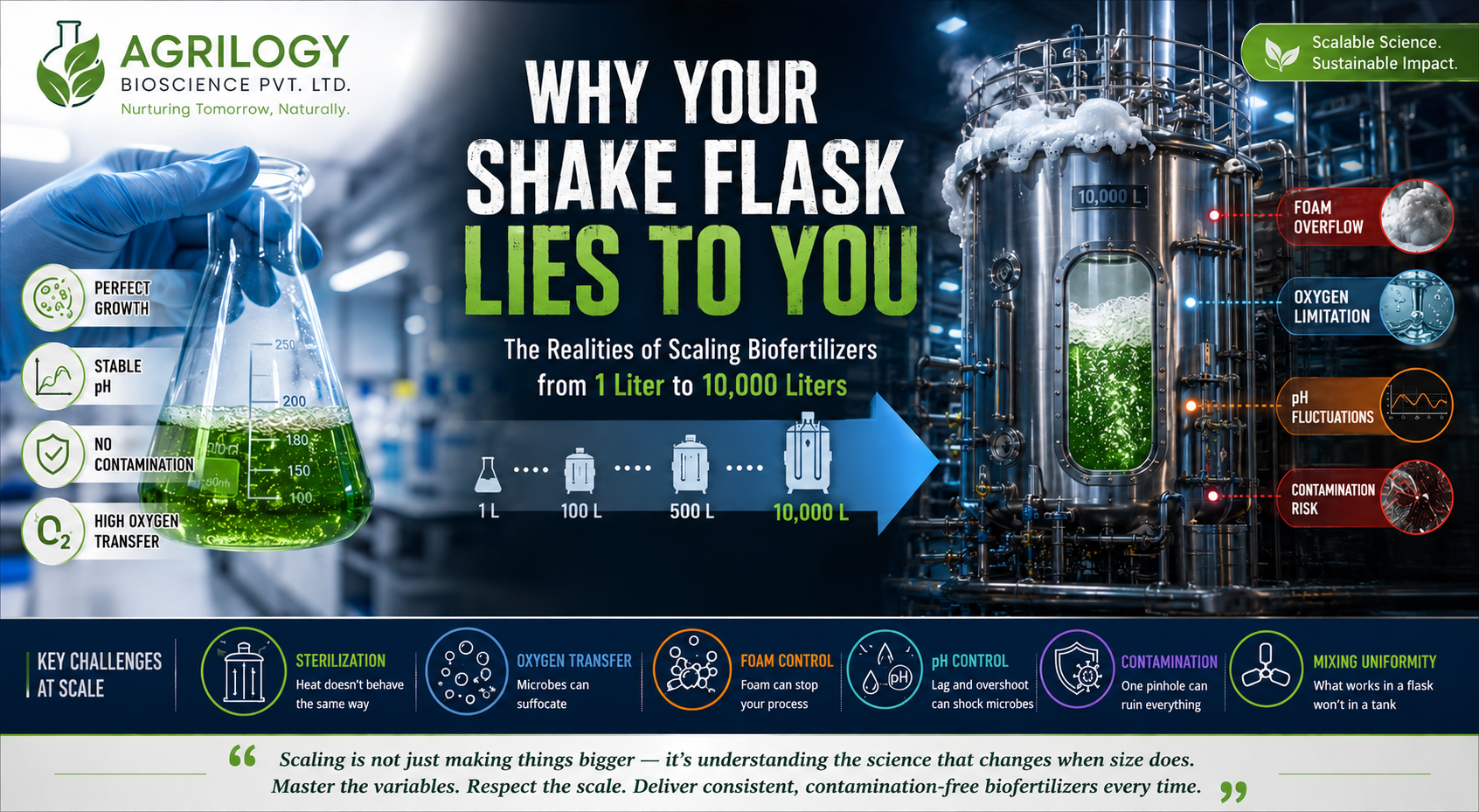
Why Your Shake Flask Lies to You: The Realities of Scaling Biofertilizers to 10,000 Liters
You made a perfect 1L batch. Good growth, clean microscopy, nice pH curve. Everyone’s happy.
Then the boss says: “Scale it to 10,000 liters.”
It sounds simple. Just use a bigger tank, right? Wrong. Here’s the actual science of why small-scale success doesn’t guarantee large-scale wins—and what you can do about it.
1. Sterilization: Heat Doesn’t Behave the Same Way
The problem at 1L:
Your autoclave saturates the flask with steam. Heat penetrates quickly. The whole flask reaches 121°C within minutes.
The problem at 10,000L:
A large bioreactor has thick walls, internal coils, and dead zones. Steam or electric heating creates temperature gradients.
- Near the heating jacket: Too hot → caramelized sugars, denatured vitamins.
- In the center or near the bottom: Too cold → surviving spores (Bacillus, fungi).
Deeper explanation:
Heat transfer is governed by surface area to volume ratio. A 1L flask has high surface area relative to volume. A 10,000L tank? Very low. So heat moves slowly. Also, liquid convection isn’t enough—you need active mixing during sterilization, but many reactors can’t stir while heating.
What to actually do:
- Use live steam injection directly into the medium (faster, more uniform).
- If using jacket heating, hold sterilization longer (e.g., 45-60 min instead of 20 min).
- Map temperature with multiple probes before your first real run.
- Never assume “it works at small scale” means it works big.
2. Oxygen Transfer: Your Microbes Are Suffocating
The problem at 1L:
A flask on an orbital shaker creates a huge gas-liquid interface. Oxygen dissolves easily. The shaking also constantly renews the surface.
The problem at 10,000L:
In a deep tank, an air bubble from the sparger takes seconds to rise. By the time it reaches the top, most oxygen is already used up. Microbes near the bottom get plenty; those near the top get almost none.
Deeper explanation:
Oxygen transfer is measured by kLa (volumetric mass transfer coefficient). At 1L, kLa is naturally high. At 10,000L, kLa drops dramatically unless you force it. You increase aeration rate? Fine. But increase impeller speed too much, and shear stress rips apart delicate microbes like Rhizobium or Azospirillum. Their cell membranes literally tear.
What to actually do:
- Use higher air flow rates (but not too high—foam issues).
- Use microsparger (tiny holes) instead of a single hole for finer bubbles.
- Choose low-shear impellers (e.g., marine propellers or pitched-blade turbines), not rushton turbines.
- Measure dissolved oxygen online and keep it above 30% saturation.
- Do a kLa test (gassing-out method) before your run—don’t guess.
3. Foam: Not Cute Anymore
The problem at 1L:
A bit of foam sits on top. You might add one drop of anti-foam. Fine.
The problem at 10,000L:
Proteins, polysaccharides, and microbial byproducts stabilize foam. At large scale, the linear air velocity at the sparger creates millions of tiny bubbles. These rise as a dense foam column that can block the exhaust filter. When that happens:
- Pressure builds up → filter bursts or safety valve opens.
- Contaminants from outside get sucked in.
- Liquid foam carries microbes into the exhaust line → cross-contamination risk.
Deeper explanation:
Foam stability increases with scale because bubble residence time is longer. Also, mechanical agitation whips air into the liquid. The classic lab trick (“shake harder”) fails because big impellers create different bubble size distributions.
What to actually do:
- Use a mechanical foam breaker (spinning discs) as first line of defense.
- Add chemical anti-foam (silicon or oil-based) automatically via a foam sensor—never manually.
- Don’t over-add anti-foam: it coats cells and reduces oxygen transfer by up to 50%.
- Design your tank with extra headspace (at least 30% of total volume).
4. pH Control: The Lag Will Trick You
The problem at 1L:
You add one drop of 1N NaOH, swirl, pH changes nicely. Easy.
The problem at 10,000L:
You add 500 mL of 5N NaOH via a pump. The pH probe is at the top. The base sinks to the bottom first. For 30 seconds, the probe still reads 6.8—so the controller adds more base. Then the mixing wave hits, and pH jumps from 6.8 to 9.2. Microbes experience pH shock.
Deeper explanation:
This is called mixing time vs. response time. In a 10,000L tank, complete mixing (95% homogeneity) can take 60-120 seconds. Your pH probe and controller respond in seconds. So you overshoot. Also, many biofertilizer microbes (like Azotobacter) have narrow pH ranges (6.5-7.5). A swing of 1.5 units can stop nitrogen fixation temporarily.
What to actually do:
- Add base/acid very slowly with a peristaltic pump, not a solenoid valve.
- Position the pH probe near the addition point OR use multiple probes.
- Use a cascade control (add slowly, wait, check, then add more).
- If possible, buffer your medium (e.g., with phosphate or calcium carbonate) to resist swings.
5. Contamination: One Pinhole Ruins Everything
The problem at 1L:
You see contamination under the microscope. You dump the flask. No big loss.
The problem at 10,000L:
Contamination after 72 hours of growth means losing tens of thousands of dollars. The worst part? The cause is often something tiny:
- A leaking mechanical seal on the impeller shaft (you can’t see it, but air gets in).
- A cracked sight glass (thermal stress from sterilization cycles).
- Backflow from a harvest valve that wasn’t steamed properly.
- Condensate from the exhaust line dripping back into the tank.
Deeper explanation:
At large scale, the pressure differential changes constantly. When you cool down after sterilization, the tank pulls a vacuum. If any seal leaks inward, airborne spores get sucked in. Also, biofertilizer media are rich (molasses, peptone, yeast extract)—perfect food for any contaminant.
What to actually do:
- Do a pressure hold test (0.5-1 bar air, hold for 30 minutes, no drop).
- Inspect every gasket and O-ring before every run. Replace annually.
- Maintain positive sterile air pressure on all seals using a barrier system.
- Steam all inlet and outlet ports before and after inoculation.
- Have a contamination response plan (when to dump, when to try to salvage).
6. Nutrient Uniformity: Some Microbes Feast, Some Starve
The problem at 1L:
Shaking mixes everything perfectly. Every microbe gets the same sugar and minerals.
The problem at 10,000L:
Without perfect mixing, denser components (like molasses or phosphate salts) can settle. Also, microbes growing faster at the bottom consume oxygen and release acids. The top zone might be sugar-depleted while the bottom still has plenty. You get heterogeneous growth—different cell densities in different zones.
Deeper explanation:
Large tanks have dead zones (near baffles, corners, the bottom dish). In these zones, mixing is poor. Microbes there age, lyse, and release enzymes that can spoil the whole batch. Also, if you feed nutrients (fed-batch), the feed point location matters enormously. Feed at the top? Sugar sinks slowly. Feed at the bottom? Local high concentration inhibits growth (substrate inhibition).
What to actually do:
- Use dual impellers (one top, one bottom) with axial flow blades.
- Take samples from top, middle, and bottom ports—don’t trust one sample.
- Add feed near the middle impeller for fastest distribution.
- Run a mixing time test using a dye or salt pulse before your culture.
The Lab Worker’s Reality Checklist
Before you approve that 10,000L run, ask:
- Did we pilot at 100L or 500L? (Never skip this. The jump from 100L to 10,000L is hard enough. 1L to 10,000L is impossible without intermediate scale.)
- Are our probes calibrated and response-tested at large scale? (pH and DO probes behave differently in deep tanks.)
- Do we have online foam control? Not a bottle in your hand.
- Is our inoculum train big enough? (10,000L needs at least 500-1000L of healthy starter, grown in a seed reactor. One shake flask won’t cut it—lag phase will be days long.)
- Have we done a water run (no microbes) to check mixing, sterilization, and cooling?
Final Honest Take
Scaling up is humbling. Your beautiful 1L process will break in the big tank. That’s not failure—that’s physics.
But here’s the real secret: every large-scale problem is just a small-scale problem you didn’t notice because the numbers were tiny. Now you see it. Now you can fix it.
Take it slow. Test everything. Respect the tank. And always, always have extra anti-foam within arm’s reach.