
- Home
- Beauveria bassiana: Strong on Pests, Gentle on the Environment

Aditi Bijalwan
Co-founder at Agrilogy Bioscience Private Limited
Precision biology, not chemical aggression
Beauveria bassiana is often grouped with “broad-spectrum” biopesticides—but its behavior in the field tells a very different story from chemical insecticides.
It does not kill indiscriminately.
It acts only where biology allows it.
This built-in selectivity is why Beauveria bassiana has remained effective, safe, and relevant in agriculture for decades.
A Biological Filter — Not a Chemical Hit
Chemical insecticides work by force: nerve poisoning, metabolic collapse, or respiratory failure.
Beauveria bassiana works through biological compatibility.
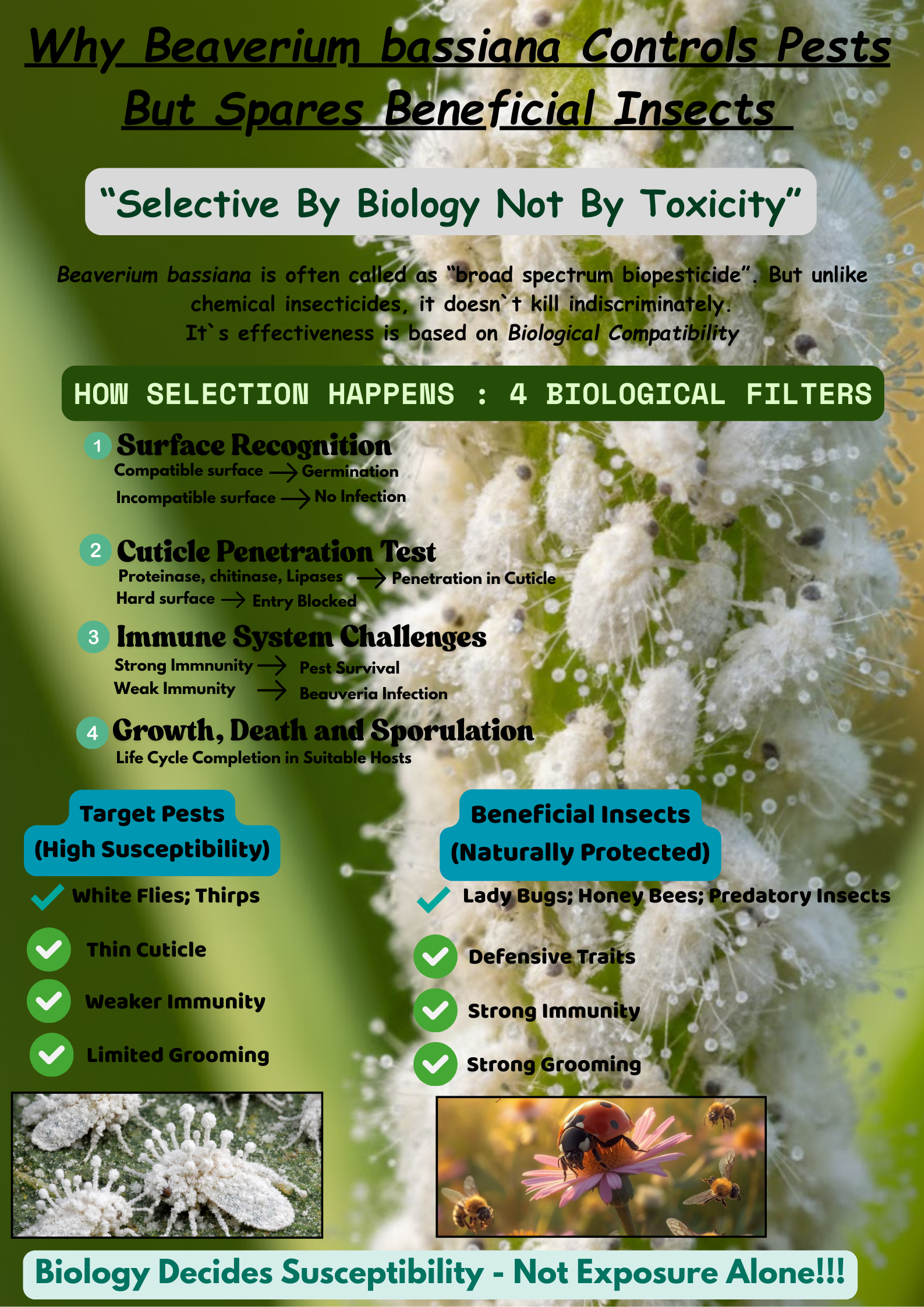
Every insect it encounters must pass multiple biological filters before infection can occur.
If even one filter fails, the fungus stops.
Step 1: Surface Compatibility Comes First
When fungal spores land on an insect, nothing dramatic happens immediately.
The spore first “reads” the insect’s outer surface i.e. epicuticle.
Each insect species has a unique mix of waxes, lipids, cuticle proteins, and surface microbes.
Only when this chemistry is compatible does the spore germinate. Otherwise, it remains inactive or dies.
Outcome: Many insects are naturally ignored.
Step 2: The Cuticle Barrier
In susceptible pests, the fungus forms a penetration structure and releases enzymes that dissolve cuticle components.
- Soft-bodied insects are more vulnerable
- Thick, hardened, or chemically defended cuticles often block entry
Outcome: Physical structure determines susceptibility.
Step 3: Immune Strength Decides the Battle
If the fungus enters the insect body, it must survive immune defenses.
- Insects with slow or weak immune responses are easily colonized
- Others respond rapidly with immune cells, antimicrobial compounds, and melanization that restrict fungal growth
Outcome: Strong immunity equals natural resistance.
Step 4: Controlled Completion of the Cycle
Only when the fungus can grow freely inside the insect does it cause death and emerge to sporulate.
This ensures Beauveria bassiana:
- Multiplies only in suitable hosts
- Does not spread uncontrollably
- Remains ecologically self-limiting
Why Beneficial Insects Are Usually Safe?
Beneficial insects are protected by a combination of:
- Efficient grooming behavior
- Strong immune defenses
- Protective surface microflora
- Cuticle chemistry that resists fungal enzymes
Pollinators and predators are not immune, but under normal field use they are biologically well defended.
Humans and animals lie completely outside the fungus’s range due to higher body temperature and complex immunity.
What This Means for Farmers?
The real strength of Beauveria bassiana lies in precision, not aggression.
✔ Effective against major sucking and chewing pests
✔ Preserves beneficial insects
✔ Leaves no chemical residues
✔ Supports resistance-free pest management
Important: Strain selection matters! Different strains are adapted to different pests.A well-matched strain delivers consistent results; a poor match leads to disappointment.
Beauveria bassiana does not kill by force.
It succeeds only where biology allows it.
That selectivity is what makes it strong on pests, yet gentle on the environment—and why it stands at the core of sustainable and organic pest management.
At Agrilogy Bioscience Pvt. Ltd., our Beauveria bassiana formulations are developed with this exact principle in mind:
strain precision, biological compatibility, and field-level reliability—so farmers control pests effectively without disturbing beneficial insects, soil life, or ecological balance.
Because true pest control isn’t about killing everything—it’s about targeting only what needs to be controlled.
Explore Agrilogy Bioscience’s biologically precise Beauveria bassiana solutions for sustainable, residue-free pest management.
Comments (0)
No comments yet. Be the first to comment!
Search Blogs
Recent Blogs


The Biology of Water Activity
August 7, 2026
What the Green on Our Trays Is Really Telling Us
July 29, 2026

Leave a Comment